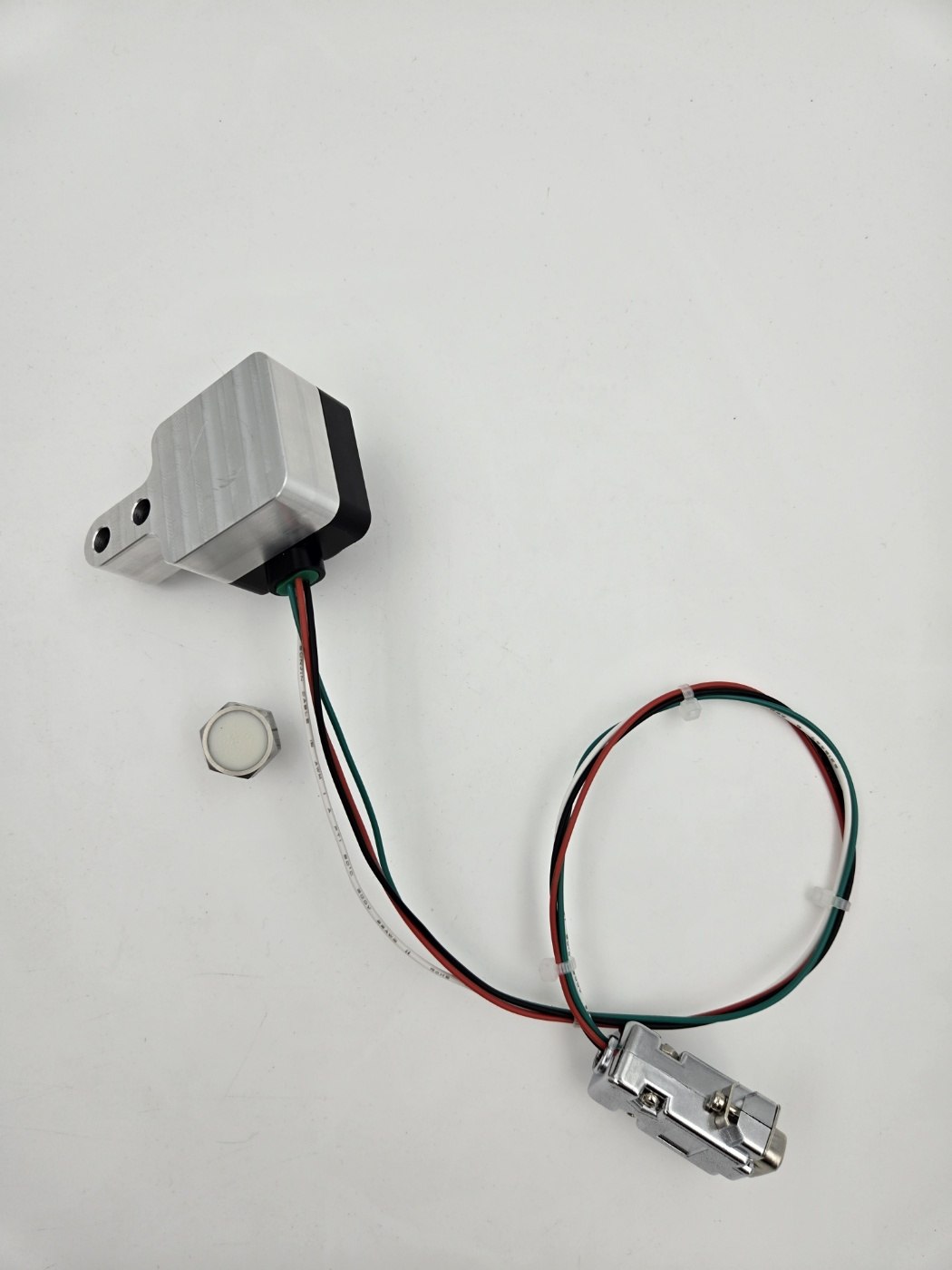
Product 01 / Angle sensor

Absolute angle.
Ready for harsh environments.

Dual-channel, non-contact magnetic angle sensing. Integrate with CAN J1939 and adapt the mounting, harness and communication to your equipment.

Measurement range
360°
Resolution
14 bit
Protection
IP69K
Operating temperature
−40 ~ +125 °C
Angle sensor, magnet bolt and harness
Sensor · Magnet bolt · Harness

Overview Non-contact Magnetic Angle Sensor — 360° · 14 bit · CAN J1939

A dual-channel non-contact magnetic sensor measuring the absolute angle of a rotating shaft. Non-contact sensing means no wearing parts; the full 360° range is resolved at 14 bit (0.022°), and angle values are transmitted together with diagnostics over CAN (J1939). IP69K sealing, a −40 to +125 °C operating range and DC 5–32 V supply keep it performing where vibration, shock and moisture are constant. In series production for Volvo CE excavators — a field-proven platform.

  • Dual-channel cross-check — the two channels are continuously compared to detect anomalies
  • Error history storage — up to 100 error codes with accumulated operating hours stored in NVSRAM, retained through power-off and retrievable over CAN
  • Double O-ring sealing — seals the air gap between sensor and magnet bolt against moisture and contaminants
  • Customizable to specification — measuring range, communication and mounting adapted to your system (see customization below)
Angle sensor — key specifications
SensingNon-contact magnetic, dual channel
Measurement range360°
Resolution14 bit (0.022°)
Non-linearityWithin ±0.4%
Output interfaceCAN 2.0B extended ID / J1939
500 kbit/s · 10 ms frame rate
Supply voltageDC 5 – 32 V
Max operating speed3,600°/s
SealingIP67 · IP68 · IP69K
Operating temperature−40 to +125 °C
Storage temperature−55 to +125 °C
VibrationBS EN 60068-2-64
31.4 gn rms, 20–2,000 Hz random
Functional safetyDesigned to ISO 13849-1
MTTFd > 150 years
ProtectionShort-circuit protection, all-to-all
DiagnosticsError log (NVSRAM, 100 entries) · CAN retrieval
ApplicationsConstruction equipment · robotics · vehicles · industrial systems
Production reference: Volvo CE excavators (Dig-Assist option)
CustomizationMeasuring range · communication · connector/harness · mounting
Verification status
  • ISO 16750 environmental & electrical tests passed (KATECH)
  • EMC passed — ISO 13766 (ESD · BCI · RE · RI)
  • CAN interface conformance test passed
  • MTTF test passed (436,714 hours)
  • Field validation — 3 months of continuous excavator operation, no error logs

Datasheet in preparation. Contact us for detailed specifications.

Applications

Where it fits

Anywhere a rotation angle must be measured accurately, for years. The sensor is engineered for environments where vibration, shock, moisture and dust are constant.

Construction equipment

Excavator swing angle, boom and arm joint angles, outrigger deployment — absolute angle measurement under high vibration and shock.

Swing angle Joint angle High vibration

Robotics

Joint position feedback, AGV/AMR steering angle, absolute position of rotating axes — non-contact sensing means no wear even under continuous motion.

Joint feedback Steering angle No wear

Vehicles · agriculture · special machinery

Steering angle sensing, implement angle, cab tilt — connects directly to DC 5–32 V vehicle power and integrates into the CAN (J1939) network as-is.

Steering angle Implement angle Vehicle network

Industrial systems

Rotary stage position, valve and damper opening, solar and wind tracking angles — IP69K sealing allows outdoor and washdown environments.

Opening angle Outdoor use IP69K

Reference

Key customer & application — Volvo CE excavators

The sensor is in series production for excavators of Volvo Construction Equipment, a global construction-equipment OEM — measuring the relative rotation between upper and lower structures at the turning joint, used by the Dig-Assist option.

  • Series production — supplied to the Volvo CE production line after passing design and production validation
  • Drop-in compatible — replaces the existing sensor with no mounting changes
  • Field validation — 3 months of continuous excavator operation, no error logs
  • CAN conformance — interface verified in a Volvo conformance test environment

Customization

Customized to your specification

Circuit, firmware and mechanical design are all done in house — so on top of a field-proven sensor platform, we can configure the specification your system needs, fast.

Measurement

Measuring range (any segment within 360°), output scaling and offset, rotation direction and frame rate configured to the application.

Communication & output

CAN 2.0B / J1939 message map and IDs matched to your network design, with support for required protocols and diagnostic messages.

Mechanical & mounting

Bracket and housing geometry, connector type, harness length and magnet-bolt specification built to the machine's mounting conditions.

Diagnostics & functional safety

Error-code policy, logged history items and dual-channel cross-check behavior adjusted to your system's functional-safety requirements.

In development

Next generation — inductive angle sensor

As the successor to the current magnetic sensor, we are developing an inductive angle sensor that measures angle through coil coupling, with no magnet. Targeting series production in H2 2027, with a prototype due late 2026.

  • Immune to external magnetic fields — no magnet dependency, stable next to motors and electromagnets
  • Robust to metallic contamination — stronger than magnetic sensing in metal-dust environments
  • Coil pattern design secured — the core design elements are developed in house
  • Platform continuity — built on the proven CAN (J1939) communication and diagnostics architecture
Open for application review
  • Still in development — customer requirements can be reflected in the design now
  • Send us your measuring range, interface and mounting requirements and we will review them

Need a different specification?

We develop to customer requirements — measuring range, output interface, mounting geometry. Send us your requirement sheet and we will review it.

Application review

Start with your equipment requirements.

Share your application, measuring range, CAN requirements, mounting conditions and expected quantity or schedule. You can also request drawings and technical documentation.

Email application requirements

Opens your email app.

View contact details →